Most companies are implementing AI the wrong way
Many organizations start with a simple scenario — employees use tools like ChatGPT, data is sent to external services, the first automations appear, and the company expects quick efficiency gains.
The real problems appear later. AI starts processing documents, customer data, emails, financial information, infrastructure configurations, or internal knowledge. Suddenly, API costs begin to rise, the company loses control over its data, processes become chaotic, integrations are improvised, and the entire setup depends on a single vendor.
That is usually the moment organizations begin looking at private or on-premise AI.
What exactly is on-premise AI?
On-premise AI means running models within your own infrastructure instead of relying entirely on cloud services.
In practice, this usually involves virtualization or container platforms, GPU servers, private model endpoints, monitoring systems, and integrations with ERP, CRM, and internal business processes. More and more companies are also building their own employee interfaces and private APIs for interacting with models.
The growing popularity of open-source models has transformed local AI from a purely experimental technology into a realistic business option. In many use cases, model quality is already sufficient — especially where data privacy, internal integrations, and predictable operating costs matter more than benchmark scores.
The biggest challenge is not AI — it is architecture
Most AI initiatives do not fail because of the model itself. In reality, the biggest problems appear much earlier — at the level of processes, data management, and overall system architecture.
Many companies deploy AI as if it were just another messaging application. They buy access to a model, add a chatbot, and assume automation will “happen automatically.” The problem is that AI without integration into business processes quickly becomes nothing more than an expensive chatbot.
The real issues usually appear only after production rollout:
- lack of control over data flows,
- chaotic operational processes,
- poor documentation quality used in RAG pipelines,
- incorrect data segmentation,
- high model response latency,
- rising inference costs,
- no GPU utilization monitoring,
- customer isolation problems in multi-tenant environments,
- lack of redundancy and backup procedures,
- operational complexity caused by running multiple models simultaneously.
In many organizations, everything initially works well with a few users and a single process. Problems appear only when AI starts supporting larger numbers of processes, integrations, and datasets.
That is when companies realize that AI environments increasingly resemble traditional production infrastructure requiring monitoring, cost control, security, environment isolation, and predictable architecture.
Where does on-premise AI start making practical sense?
Internal knowledge assistants
One of the most valuable use cases is a private AI assistant connected to documentation, internal wikis, tickets, procedures, technical knowledge, and company documents.
Instead of manually searching through systems, employees receive contextual answers within seconds. In practice, these systems are typically built using RAG architectures, embedding vectors, and vector databases.
AI in DevOps and infrastructure operations
This is currently one of the fastest-growing areas of AI adoption.
Models are beginning to support not only log analysis and incident summaries, but also real infrastructure operations. AI is increasingly becoming part of the daily workflow of administrators, DevOps engineers, and SRE teams.
This is especially visible in environments built around Kubernetes, VMware, virtualization platforms, infrastructure monitoring, and SIEM security systems.
In practice, AI is increasingly used for:
- application and infrastructure log analysis,
- alert correlation across multiple systems,
- performance anomaly detection,
- incident analysis,
- troubleshooting,
- root cause analysis,
- infrastructure automation,
- configuration analysis,
- deployment and change summaries.
Organizations are also increasingly building agent-based AI workflows capable of analyzing monitoring systems, ticketing platforms, and CI/CD pipelines.
In practice, models analyze telemetry and operational data from platforms such as Prometheus, Grafana, Elasticsearch, Loki, Wazuh, Zabbix, GitLab, Jenkins, ticketing systems, and Git repositories.
This does not necessarily mean these platforms contain built-in AI features. More commonly, AI models analyze monitoring data, logs, alerts, tickets, and deployment history to help teams identify issues faster and reduce manual operational work.
However, this also introduces entirely new architectural challenges.
In production environments, AI systems quickly begin generating massive volumes of telemetry and logging data. Organizations also face inference costs, model maintenance overhead, response latency, and contextual limitations.
Many companies are discovering that models without access to live infrastructure context often generate inaccurate recommendations or fail to understand service dependencies.
That is why modern AI operations increasingly rely on:
- RAG,
- CMDB integrations,
- observability data,
- infrastructure topology awareness,
- incident history,
- deployment workflow integrations.
This is where the difference between a simple AI chatbot and a real infrastructure operations platform becomes visible.
ERP, automation, and business processes
The real value of AI appears only when models become part of a business workflow.
AI can analyze invoices, classify emails, process OCR, analyze CRM data, generate responses, trigger workflows, and integrate systems.
That is where AI begins delivering measurable operational savings.
AI for software engineering teams
One of the fastest-growing areas today is AI tooling for developers.
AI is evolving far beyond simple code autocompletion. It is increasingly becoming a core part of the software development lifecycle — from code generation and change request analysis to automated code review and agent-based development workflows.
This is especially visible in tools such as GitHub Copilot, Cursor, and Claude Code, as well as AI systems integrated directly into development environments and CI/CD pipelines.
In practice, many organizations are beginning to realize that AI-generated code alone does not solve software quality problems.
New challenges are emerging:
- AI generates insecure code,
- models lack full architectural context,
- logical bugs become harder to detect,
- teams lose visibility into generated code quality,
- risks of secret leakage and data exposure increase.
Research continues to show that AI-generated code may still introduce vulnerabilities such as SQL injection, XSS, or insecure deserialization. As a result, organizations increasingly combine AI development assistants with security tooling and traditional code review processes.
AI is also increasingly integrated into CI/CD and DevSecOps platforms, where models assist with vulnerability analysis, change review, secret detection, dependency analysis, and security workflow automation.
AI and security — a new attack surface
The rapid growth of AI in software development is also creating entirely new security risks.
More and more organizations are realizing that AI-powered development environments and agent-based workflows often have extensive access to:
- repositories,
- terminals,
- secrets,
- CI/CD pipelines,
- ticketing systems,
- development infrastructure.
This effectively makes AI another component of the attack surface.
In recent months, there have already been incidents involving malicious Visual Studio Code extensions used to compromise repositories and exfiltrate source code. Security researchers are also increasingly warning about prompt manipulation attacks, secret leakage, and vulnerabilities introduced by autonomous AI agents operating within development environments.
As a result, many organizations are beginning to treat AI like any other critical infrastructure component:
- with monitoring,
- access control,
- environment isolation,
- auditing,
- security policies,
- additional DevSecOps layers.
That is where a more mature approach to AI begins — not as a developer gadget, but as infrastructure requiring real governance and security controls.
Cloud AI still makes enormous sense
On-premise AI is not the right solution for every organization.
For many companies, cloud AI remains the best option — especially because of rapid deployment, zero GPU maintenance, elastic scaling, and access to the most advanced models.
In practice, hybrid architectures are often the most effective approach, where less sensitive workloads run in the cloud while critical data remains local.
Dedicated AI infrastructure and private AI environments
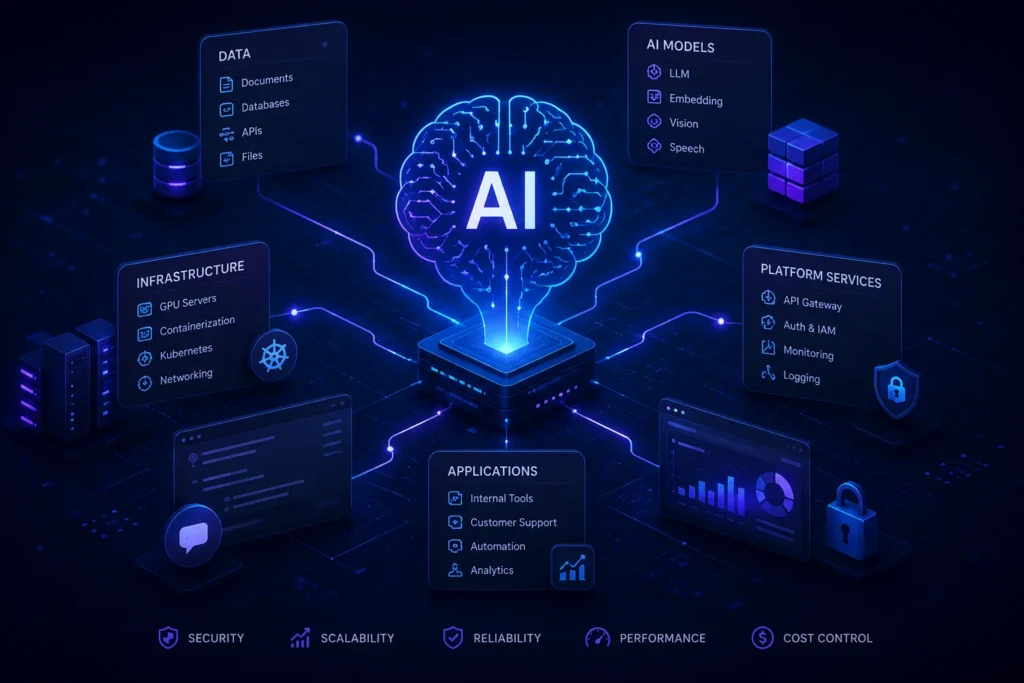
More and more organizations are realizing that AI increasingly resembles another layer of enterprise IT infrastructure — similar to servers, storage arrays, or Kubernetes environments.
As a result, companies are becoming interested in:
- private AI environments,
- AI-optimized VPS infrastructure,
- dedicated GPU instances,
- isolated customer environments,
- AI model hosting,
- private platforms such as Open WebUI.
For many organizations, this becomes a practical compromise between fully local AI and traditional cloud AI.
The company does not need to build its own data center or operate the entire environment internally, while still maintaining stronger control over data, costs, and architecture.
This becomes especially important for organizations that:
- want to run proprietary models,
- require data isolation,
- integrate AI with ERP or CRM systems,
- build automation workflows,
- want to reduce vendor lock-in,
- require predictable operational costs.
Increasingly, these environments are being deployed as:
- dedicated AI VPS platforms,
- private GPU clusters,
- Kubernetes environments optimized for AI,
- private model APIs,
- organization-specific RAG platforms.
That is the point where AI stops being a technology demo and becomes a real production environment supporting day-to-day business operations.
AI increasingly resembles infrastructure
Not long ago, AI was viewed mostly as a curiosity or a chatbot. Today, organizations are approaching it very differently.
Companies are now asking questions about architecture, security, monitoring, redundancy, operational costs, integrations, compliance, and vendor lock-in.
That is where real AI adoption actually begins — not with prompts, but with infrastructure, integrations, and business processes.
Summary
Cloud AI and on-premise AI are not competitors. The key is aligning the solution with the actual needs of the organization.
For some companies, rapid cloud adoption will be the best approach. For others, control over data, infrastructure, and operational costs will become critical.
In the end, the greatest value still comes not from the AI model itself, but from well-designed business processes supported by the right architecture.