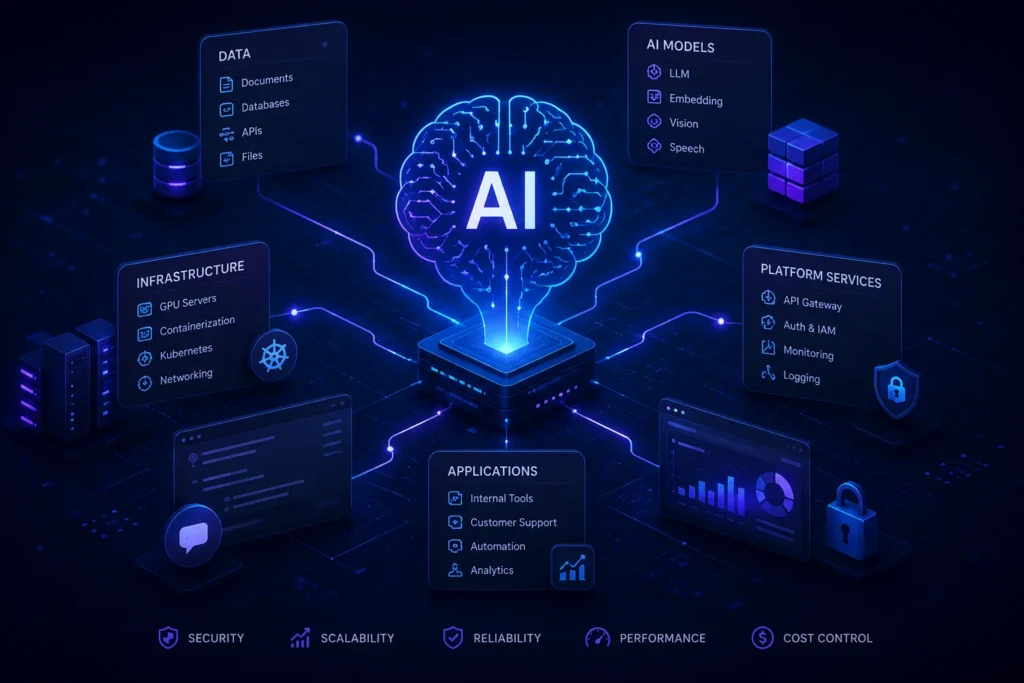

When people think about artificial intelligence, they often focus mainly on the models themselves. They talk about LLMs, embeddings, RAG, inference, fine-tuning and the quality of generated responses. These are all important areas, but in real-world projects another, less visible yet critical topic appears very quickly: infrastructure.
An AI model has to run somewhere. If it needs GPU acceleration, the environment must be properly prepared across multiple layers: hardware, drivers, operating system, containers and orchestration.
Simply having a graphics card installed in a server does not mean that the organization already has a production-ready AI platform.
Why Kubernetes for AI?
Kubernetes works well wherever workloads need to be deployed in a repeatable, controlled and automated way.
This is particularly important for AI models. Different models may require different versions of libraries, CUDA, Python, system dependencies, RAM, CPU and VRAM. Running everything manually on a single server can quickly turn into operational chaos.
Containerization allows an application and its dependencies to be packaged into a container image, while Kubernetes provides the mechanisms to manage those containers: scheduling, restarting, scaling, resource allocation and health control.
As a result, an AI model is no longer just “a process running on a server”. It becomes a declaratively managed workload.
GPUs in Kubernetes Add Another Layer of Complexity
CPU and RAM are relatively straightforward resources in Kubernetes. GPUs are more complex because they require proper integration with the hardware and driver layers.
For a container to use a GPU, the entire chain of dependencies must work correctly: hardware, BIOS, IOMMU, hypervisor or bare-metal operating system, NVIDIA drivers, container runtime, Kubernetes GPU plugin and a properly defined workload specification.
If even one part of this stack is misconfigured, the application may not see the GPU at all, may detect it incorrectly or may behave in an unstable way.
That is why designing AI infrastructure is not only about Kubernetes itself. It requires thinking about the entire technology stack.
Virtualization or Bare Metal?
One of the key architectural questions in AI environments is whether Kubernetes should run directly on physical servers or inside virtual machines.
Bare metal usually provides simpler and more direct access to hardware. Virtualization, on the other hand, offers greater operational flexibility, easier machine management, better environment separation and smoother integration with existing infrastructure.
In practice, both approaches can make sense. If an organization already uses VMware, a natural direction is often to prepare Kubernetes nodes as virtual machines and pass GPUs through to selected VMs.
However, this approach requires proper GPU passthrough configuration and careful stability testing.
GPU Sharing – When Does It Make Sense?
In theory, sharing a GPU across multiple workloads sounds very attractive. A single graphics card can serve several tasks, and resources can be utilized more flexibly.
In practice, the answer is: it depends.
If workloads are small, predictable and do not consume much VRAM, GPU sharing can provide meaningful benefits. But if the models are large, heavily use GPU memory and require stable performance, sharing the accelerator may become a source of problems.
There is also additional complexity: licensing, configuration, diagnostics, compatibility and monitoring.
Sometimes the best solution is the simplest one: one physical GPU resource assigned to a specific workload. It is less flexible, but more predictable.
The Biggest Mistake: Starting with Tools Instead of Architecture
AI projects can easily fall into the trap of focusing on technology first. Kubernetes, GPU Operator, vGPU, CUDA, Triton, MLflow, Kubeflow — there are many tools available, and each of them looks attractive.
The problem is that not every tool solves a real problem for a given organization.
Before implementation, it is worth answering several key questions:
What models will be deployed? How much VRAM do they require? Will the workloads run continuously or only periodically? Is maximum performance more important than flexible resource sharing? Should the environment support inference, training, experimentation — or all of these at once? Who will maintain the platform after deployment?
Without these answers, it is possible to build a very advanced environment that is difficult to maintain and poorly aligned with real business needs.
Good AI Infrastructure Is Boring – and That Is a Good Thing
A well-designed AI infrastructure should not require constant manual intervention. It should be predictable, observable and reproducible.
This means taking care of driver versions, CUDA compatibility, container image control, GPU resource definitions, VRAM utilization monitoring, logging, resource limits and update procedures.
The best infrastructure is the kind that does not constantly attract attention after deployment. It simply works, allowing the team to focus on models and applications instead of troubleshooting system-level issues.
Summary
Running AI models on GPUs is not only a matter of compute power. It is a full infrastructure project that requires the right architectural decisions from the very beginning.
Kubernetes can be a strong foundation for AI workloads, but only when the entire technical layer is properly prepared: virtualization, operating system, NVIDIA drivers, container runtime, GPU integration and resource monitoring.
In practice, the greatest value is not just “running the model”. The real value lies in creating an environment that is stable, maintainable and capable of delivering predictable performance. Sometimes this means choosing a simpler solution instead of a more complex architecture, if that makes the system easier to diagnose and safer to operate.
If you are planning to run AI models in your own infrastructure, want to use GPUs in Kubernetes or need to organize an existing AI environment, we can help design, implement and maintain such a platform.
At Implsoft, we combine expertise in virtualization, Linux, Kubernetes, containerization, GPU infrastructure and infrastructure security. This allows us to build environments tailored to real needs – from a single GPU server to a more advanced platform for AI workloads.